
The MINEX Forum
MINEX Europe 2026
Forum’s Five Takeaways: Trust, Data and Public Capital Decide What Gets Mined
The 10th MINEX Europe Forum held its closing session in Trim, Ireland, on 29 October. Across the programme, from the pre-forum workshop to the final session, mining companies, investors, geological surveys and policy makers asked one question. Europe has the geology, the data and a policy framework for critical raw materials. Why does so little of it reach production?
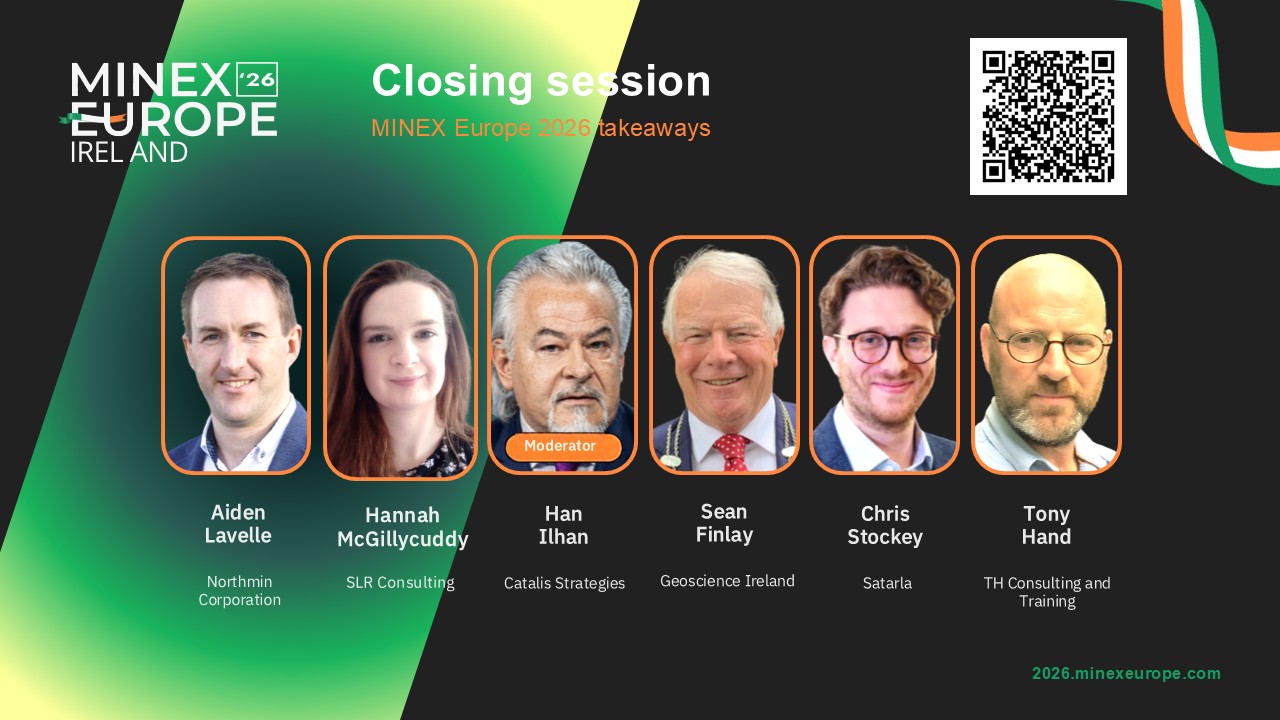
The closing session, moderated by Han Ilhan of Catalis Strategies, pulled the answers together. Han invited the moderators of the previous sessions to give their conclusions: Aiden Lavelle, Hannah McGillycuddy, Sean Finlay, Chris Stockey and Tony Hand. Five themes stood out.
- 1
Ireland shows what a geological survey can do
Han Ilhan called Ireland’s approach to its geological survey a business model for other jurisdictions. He linked it to friend-shoring. In Central Asia, only 20 to 30 per cent of each country is explored. State-owned enterprises there are looking for exploration partners. A survey-led partnership, on the Irish or USGS model, gives Europe and the US early access to the critical minerals they need.
The Irish numbers back this up. Aiden Lavelle of Northmin Corporation noted that Ireland ranks among the top EU countries for exploration budgets. With Sweden, Finland and Spain, it accounts for 75 per cent of all exploration drilling in Europe. Galmoy has a new permitted mine, and a mining licence has been granted at Shrule. Companies in the Geoscience Ireland network report a turnover of 1.12 billion, 38 per cent of it international.
Hannah McGillycuddy of SLR Consulting pointed to the quality of the public data. Tellus and Geological Survey Ireland datasets enter the public domain quickly, in usable formats. Irish companies often take this for granted. Not every country offers it.
- 2
Who pays for early-stage exploration?
Han Ilhan put a direct proposition. Governments, not the mining industry, classified these minerals as critical, because their manufacturers are exposed to a dominant supplier in China. If the minerals are critical to the national economy, public capital should help fund exploration.
Tony Hand of TH Consulting and Training agreed, perhaps as matching funds for private money. He noted that greenfield risk capital is a smaller pot than it was. Cannabis and then crypto drew money away from exploration companies.
Sean Finlay, Chair of Geoscience Ireland, said the new Irish Minerals Fund is keen to invest. Its 30 million is not a limit. Hannah McGillycuddy added a European angle. The TEN-E regulation already funds strategic energy links such as Greenlink. If Europe is serious about the Critical Raw Materials Act, she argued, it should fund its strategic projects too.
- 3
Strategic status is not permitting
Chris Stockey of Satarla raised a common misconception. Strategic project status is granted in Brussels. Permitting sits with municipal and regional authorities. The two do not connect automatically, yet the industry expects them to.
He argued that the delay is rarely in the permitting itself. It is in the work before it, and that comes down to trust. Drawing on Irish social science research, he described trust as three perceptions: competence, integrity and benevolence. Irish stakeholders believe the sector can do the job. Their doubts concern integrity and benevolence. Most forum presentations, he noted, addressed competence.
Sean Finlay offered two practical steps. Reactivate the government’s Minerals Advisory Group, which has fallen into disuse. And introduce concurrent permitting, to avoid timelines such as the 18 years cited for one project. Tony Hand put the journey from exploration site to mine at up to 20 years.
- 4
The industry needs a new global mining initiative
Han Ilhan recalled the Global Mining Initiative of about 25 years ago, which produced the ICMM. Companies now handle community relations well at project level. At industry level, he said, little has been done since. He proposed a new global outreach programme, covering key mining jurisdictions as well as host communities, and suggested the ICMM lead it. Sean Finlay agreed that the ICMM needs to become active again.
- 5
AI, skills and the copper problem
Tony Hand linked technology to metals. Data centres, electric vehicles and the charging networks behind them all need copper. Yet the mining sector moves slowly while AI advances quickly. AI can also be bent to tell any story. Without open data and trust, he warned, stakeholders will doubt what mining companies say.
He also asked why industry complains about graduate skills without working with universities on course design. Han Ilhan agreed and went further. Industry should give academia financial support, not warm words.
What next
Aiden Lavelle’s summary was optimistic for Ireland: the people, the knowledge and the supply chain are in place, and the expertise can now be exported.
The wider message is sharper. Data, public capital and permitting reform matter. So does trust, and trust rests on integrity and benevolence as much as on technical competence.
Thank you to all speakers, moderators, sponsors and partners, and to every delegate who joined us in Trim.